windows xp, office 2003 Hindi
Microsoft has finally launched Windows XP Hindi and Office 2003 Hindi, a step which was being expected since long. Though I have not yet seen the release versions of either of these, it seems interesting and I am sure same will be the case with others who love to speak, work and live ;) in their own language.
Till the time we get hold of these softwares, we have BhashaIndia, which is a Microsoft Website that provides a number of tools to change Windows XP and office 2003 interface language to regional languages. Presently Hindi, Marathi and Tamil Language Interface Packs (LIPs) are available for Windows XP and Tamil, Konkani, Kannada, Telugu , Marathi , Gujarati and Punjabi LIPs are available for Office 2003.
It also provides tools, called Indic Input Method Editors (IMEs), to input text in regional languages using QWERTY keyboard. You can type Phonetic Hindi, Gujarati, Bengali, Tamil, Malayalam and Kannada text using these tools. It also provides a lot of other tools for fonts, publishing and development.
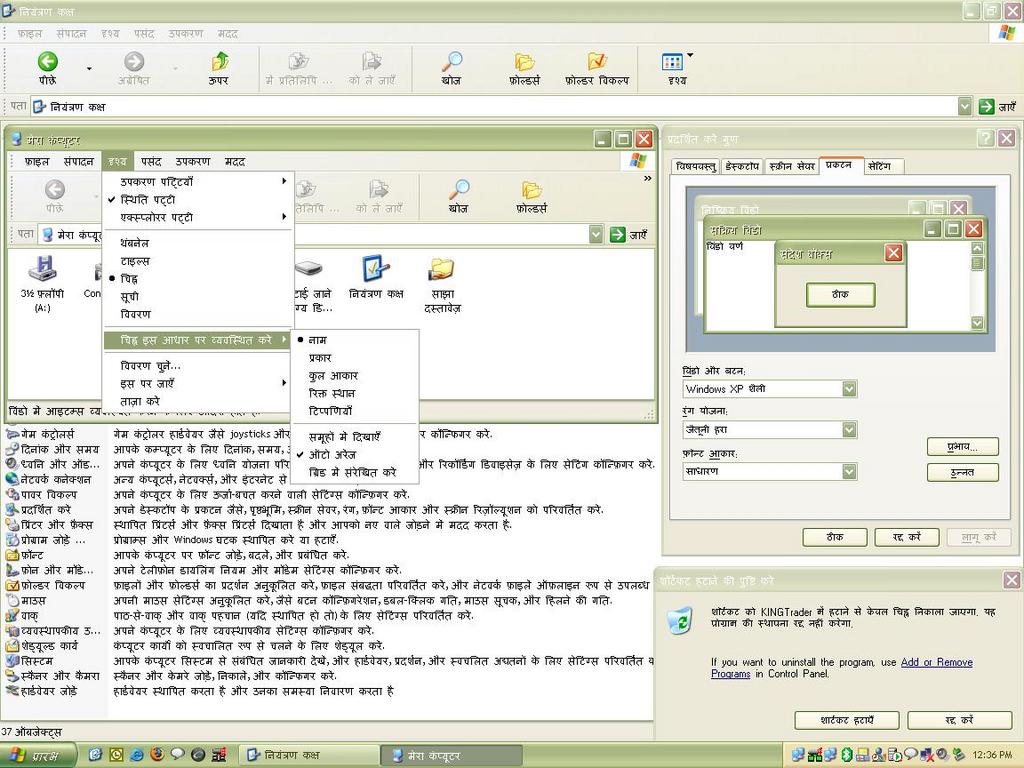 Here are screenshots of how Windows XP looks like when Windows XP Hindi Interface Pack is installed on Windows XP Professional. Most of the dialog boxes, Windows menus, progress bars text, tooltips, and even Internet Explorer menu, status bar text are all converted to Hindi.
You must have a Genuine Windows XP version to be able to install this tool or else you may download it on any Windows 98, 2000, XP computer, which according to online check is validated as Genuine.
posted by BalRam @ 4:46 pm
4 comments


4 Comments:
The dimension and horizon created by our mentor guardian of all the three organs on account of its slave orientation to drag an individual to the point of abrogation and subjugation by confining his inner instincts and his existence is an iron cage, not having any ventilation and people are living in the state of suffocation, virtually on the verge of their death point. There is a complete apathy of the custodian of the power towards their welfare and in our country "We, the people " who are regarded to be the sovereign of the nation are living a life full of abrogation and subjugation. I seldom consider that whether it is worthwhile to shout a voice and thereby invite some lighter sleeper to suffer the agony of the death and this purpose achieved through my writing may serve some purpose. Since the daylight shallow the darkness, Please Write articles to take the intellectual from apathetically approach towards rectification of prevailing maladies as to wake up
Yogesh Kumar Saxena, Advocate, High Court Allahabad (India) e mail Address yogrekha@yahoo.co.in or yogrekha@rediffmail.com Phone:- 91/ 0532/637720/2436451, Mobile:- 9415284843
TRANSFORMATION OF THE SPIRITUALITY OF SRI RAM INTO RELEGIOUS EPIC OF HOLY RAMAYAN-Great lives spread an aura and fragrance which outlive their mortal sojourn on earth. If one makes a closer study of what distinguishes these men and keeps them apart from the rest, two qualities stand out. The first is their concern for the good of others. The second is a constant striving for perfection and excellence with purity in personal and public life. Honour, dignity, friendship and compassion are the traits of such worthy men. They know intuitively that nothing worthwhile or enduring is ever achieved without character and that, in the ultimate analysis, all worldly possessions and achievements like authority, wealth and status are mere wayside stops in the exciting journey of exploration of the mortal dimensions of the human personality. Perception of impulse to stimulate the message conveyed through holy Epic of Ramayana, I remained stands still to get the meaning hidden between the lines. The realization of the truth started entering into my mind by diplection of the different character of the people living at the contemporary period of Sat-Yug. There were the jealousy in the mind of step mother Kaikei which given effect into the action by Mainthara and ultimately the king Dashrath, who has pledged to accomplish two desires of his youngest queen by the impulse of the emotion. He was compelled to denounce the thrown to his dear worthy son Shri Ram and the other vicious design uttered in the shape of boon to spare him from making his descendent heir for kingdom but to send him to the exile. The character of Shri Ram is not in the hatred, but to follow the great tradition i.e. “let my Life be Sacrificed, but there may not be unequivocal repudiation from promise”. It was not only attributable for himself, but the desire of his father and step mother for giving effect to the said promise to be carried out by accepting the offer of exile for himself. The duty of the spouse in order to accomplish the tradition of remaining shared during the good days and also to follow the bad days in services of her husband also with the equal enthusiasm. The dedication of the brother Laxman to follow his brother during the period of the adversity and to protect his sister-in-law during the absence of Shri Ram and to sleep on the earthly bed is the first and foremost lesson conveyed through the holy epic of Ramayana. The second lesson required to be learn by the different segmentation of the society comprising of the layman in the contact of the ruler from the public at large and reaction thereafter. The diplomatic conversation of Nishad Khewat with Shri Ram by not allowing him to enter in his boat till washing of his feet under the garb of alleged fear psychosis of saving his boat from being converted into the human beings conveys the message of sentimental affiliation and association by the almighty power, which is not only omnipresent, but also omniscient. Thereafter, eating the berries already tested by the women namely Shabri, lowest community of a Dhanuk (Passi), having the piggery business but instead of showing any dejection from accepting such berry, the character of Shri Ram is displayed in eating them. The most crucial part of lesson in the epic of Ramayana, when Mother Sita was abducted by Ravan and she was crying for help from all such living creatures including birds and animals, but no one listen, as the abductor was none else than Ravan. It was a Jatayun, a vulture, eating the flesh of dead animals, who dared to challenge the most powerful ruler on earth fully knowing that he will not survive, but none else came to save Mother Sita, or even to make efforts to save her except a vulture.
It is true that Shri Ram killed Bali from behind the trees but when Bali asked him, as to why Shri Ram preferred to have the friendship with his weaker brother Sugreev, who could not protect his wife from Bali aggression, instead of having the friendship from the stronger person namely the Bali who kept Ravana inside the Soldier pit below his arm for six months, the reply of Shri Ram in support of the righteous person, irrespective of his status is the second lesson conveyed in Ramayana. When the fighting could not be avoided, then instead of calling the army from Ajodhya, why Shri Ram preferred the Army comprising of the monkey, bear and even the squirrel who built the Ram Shetu to reach the golden kingdom of Ravan. Ravan was himself Brahmin by caste but on account of his conduct of consuming liquor and having the carnal desired of greed and lust, the entire quality of his worship to lord Shiva was converted into the sin committed on this earth. Thus the army of the petty animals or that of lowest segmentation of the society was having the potential to defeat him. Thus the third lesson conveyed in Ramayana is that it is not material as to which caste an individual is born, but the quality of the life and the perception of its ideology is supreme. The Fifth lesson conveyed through epic Ramayana, as to why the golden Lanka was given back to the brother Bhibhisan of Ravan, instead of having the expansion of his kingdom and to return back to his native place after completion of the period of exile of fourteen years. The Sixth lesson is having the mixed reaction, one conveys the greatness of Shri Ram while from another point of view people criticizes to Shri Ram for denouncing mother Sita ji on the instigation of the washer man but as the ruler of Ajodhya, the comfort of the king were immaterial instead of his reputation to maintain the high tradition of the kingdom. Thus ultimately the conclusion conveyed through the holy epic of Ramayana is that of the attachment with the spirit of detachment and victory over the vices, while association with lowest segmentation of society for expansion of kingdom, which the society at present, especially the so called Brahmins and swami ji in the luxurious ashrams, posing themselves to be the protector of our Vedic Hindu Religion have totally forgotten or they have given up these high traditions, only for gaining more power, more money, more comfort and ultimately started ruining the Hindu Tradition of sacrifices.
This is Bharat at the heart of Shining India. The scene repeats itself in almost every city in India. Nevertheless, when elections come-and they will in April-May-it is Bharat, which in villages or urban slums, that votes in greater numbers and with more hope. Our democracy displays an instructive contrast. Bharat votes, but does not rule. India rules, but rarely votes. As a political worker active in the election campaign, I am troubled by the thought of how to communicate to these faces of Bharat that you confront almost everywhere in the streets of India. What message can meaningfully connect the two contrasting but clearly interdependent halves of India? How can we make our democracy mean to the common man more than his five-yearly vote, and indeed give him (and her) an empowered voice? The Delhi airport, now undergoing a major renovation, tells me a lot about our Republic and our democracy. After a slow start, the work of expansion and modernisation has gathered speed, leaving visitors with a sense of pride that soon our Capital will have an airport comparable to the best in the world. Gone will be the days when it looked pathetically small and ill-maintained. A glance at the passengers' attire, baggage and air of self-confidence tells you how much the life of upwardly mobile Indians has changed in the past ten years-and also how much more it will change in the years to come. However, a look at the labourers working on the construction of the airport and allied structures and services tells a different story. They have probably come from Bihar, Jharkhand or some other poorer part of the country. Their faces are dark, their bodies ill-fed. Some wear ill-fitting helmets and women sweepers have fluorescent uniforms. In all likelihood, they carry a sense of relief at having got a job, since life back home has fewer livelihood opportunities. But there is no cheer in their faces, and no zest of the kind that well-heeled air-travellers have in their gait for after work, they have to trudge back to their tiny abode in some jhuggi-jhopadi somewhere in this rapidly expanding city, where streets are full of litter, water is scarce, sanitation is poor, healthcare costs are unaffordable and they have little time to spend with their children. Social security for contract workers in India is a joke. Some of them-indeed, many of them-must be dreaming of flying one day. At least, they would like their children to fly some day. But, right now, life is miserable. It has taught them not to be immodest in their ambition. How can we reassure them that their work for India's progress is as important and valuable as that of their more privileged counterparts?
At the airport, while waiting for a flight to Mumbai, I revisit the inaugural speech of President Barack Obama and am struck by how much his words speak to us in India. He reminded his countrymen that "a nation cannot prosper long when it favors only the prosperous. The success of our economy has always depended not just on the size of our gross domestic product, but on the reach of our prosperity; on our ability to extend opportunity to every willing heart-not out of charity, but because it is the surest route to our common good." He spoke of the need to "carry forward that precious gift, that noble idea, the God-given promise that all are equal, all are free, and all deserve a chance to pursue their full measure of happiness." He exhorted that the path to a nation's greatness is not "for those who prefer leisure over work, or seek only the pleasures of riches and fame. Rather, it has been the risk-takers, the doers, the makers of things-some celebrated, but more often men and women obscure in their labour-who have carried us up the long, rugged path toward prosperity and freedom." And when Obama spoke of the common Americans of the previous generations who built America-those who "packed up their few worldly possessions and travelled across oceans in search of a new life... men and women (who) struggled and sacrificed and worked till their hands were raw so that we might live a better life"-I could not help imagine the parallel narratives of those crores of migrant workers in our own country travelling from villages to cities "in search of a new life". Obama spoke with profound emphasis on a new cooperative relationship between government and people. "For as much as government can do and must do, it is ultimately the faith and determination of the American people upon which this nation relies." I asked myself: How much faith does the government in India have in its own people? How much does it respect and support their capabilities and aspirations? There is no mystery to why Obama's amazing presidential journey evoked so much interest in India. For, when he called upon his people "to choose our better history" and appealed to them to re-enshrine old-world values of responsibility, work, sacrifice and service, didn't his words touch Indian minds and hearts? "Our challenges may be new," he said. "The instruments with which we meet them may be new. But those values upon which our success depends-hard work and honesty, courage and fair play, tolerance and curiosity, loyalty and patriotism-these things are old. These things are true. They have been the quiet force of progress throughout our history. What is demanded then is a return to these truths. What is required of us now is a new era of responsibility-a recognition, on the part of every American, that we have duties to ourselves, our nation and the world; duties that we do not grudgingly accept but rather seize gladly, firm in the knowledge that there is nothing so satisfying to the spirit, so defining of our character, than giving our all to a difficult task. This is the price and the promise of citizenship". My flight takes off. After two hours, it lands at another airport currently undergoing renovation, an airport surrounded by sprawling slums. I reach home, my inner voice saying, "Obama, you spoke for India, too."
The Sanskrit word "Shankramana" means "to begin to move". The day on which the sun begins to move northwards is called Makara Shankranti. It usually falls in the middle of January.
Among the Tamilians in South India this festival is called the Pongal.
To many people, especially the Tamilians, the Makara Shankranti ushers in the New Year. The newly-harvested corn is cooked for the first time on that day. Joyous festivities mark the celebration in every home. Servants, farmers and the poor are fed and clothed, and given presents of money. On the next day the cow, which is regarded as the symbol of the Holy Mother, is worshipped. Then there is feeding of birds and animals.
In this manner the devotee's heart gradually expands during the course of the celebrations, first embracing with its long arms of love the entire household and neighbours, then the servants and the poor, then the cow and then all other living creatures. Without even being conscious of it one develops the heart, and expands it to such proportions that the entire universe finds a place in it.
As Shankranti is also the beginning of the month, Brahmins offer oblations to departed ancestors. Thus all the great sacrifices enjoined upon man, find their due place in this grand celebration. The worship of the cosmic form of the Lord is so well introduced into this that every man and woman in India is delightfully led to partake of n without even being aware of it.
To aspirants all over the world this day has a special significance. The six-month period during which the sun travels northwards is highly favourable to aspirants for their march towards the goal of life. It is as though the aspirant were flowing easily with the current towards the Supreme. Paramahamsa Sannyasins roam about freely during this period, dispelling gloom from the hearts of all, Devas and Rishis rejoice at the advent of the new season and readily come to the aid of the aspirant.
The great Bhishma, the grandfather of the Pandavas who was fatally wounded during the Mahabharata war, waited on his death-bed of nails for the onset of this season before finally departing from the earth plane. Let us on this great day pay our homage to him and strive to become men of firm resolve ourselves!
As already mentioned, this is the Pongal festival in South India. It is closely connected with agriculture. To the agriculturalist it is a day of triumph. He would have by then brought home the fruit of his tons. Symbolically, the first harvest is offered to the Almighty-and that is Pongal. To toil was his task, his duty, but the fruit is now offered to Him-that is the spirit of Karma Yoga.
The master is not allowed to grab all the harvest for himself either. Pongal is the festival during which the landlord distributes food, clothes and money among the labourers who work under him. What a noble act! an ideal you should constantly keep before you, not only ceremoniously on the Pongal day but at all times.
Be charitable. Be generous. Treat your servants as your bosom-friends and brother workers, This is the keynote of the Pongal festival. Thus would you earn their loyalty and enduring love.
The day prior to the Makara Shankranti, is called the Bhogi festival. On this day, old, worn-out and dirty things are discarded and burnt. Houses are cleaned and white-washed. Even the roads are swept clean and lovely designs are drawn with rice-hour. These practices have their own significance from the point of view of health. But, here I remind you that it will not do to attend to these external things alone. Cleaning the mind of its old dirty habits of thinking and feeling is more urgently needed. Burn them up with a wise and firm resolve to tread the path of truth, low and purity from this holy day onwards. That is the significance of Pongal in the life of the spiritual aspirant.
If you do this, then the Makara Shankranti has a special significance for you. For the sun, symbolising knowledge, wisdom and spiritual light, which receded from you when you reveled in the darkness of ignorance, delusion and sensuality, now joyously turns on its northward course and rushes towards you, to shed its light and warmth in greater abundance upon you and to infuse into you more life and energy.
In fact the sun itself symbolising all that the Pongal festival stands for. The message of the sun is the message of light, the message of unity, of impartiality, of true selflessness, of the perfection of the elements of Karma Yoga. The sun shines on all equally, it is the true benefactor of all beings. Without the sun life would perish on earth. It is extremely regular and punctual in its duties and never claims a reward or crave for recognition. If you imbibe these virtues of the sun, what doubt is there that you will shine with equal divine lustre!
He who dwells in the sun, whom the sun does not know, whose body the sun is and by whose power the sun shines, He is the Supreme Self the Indweller, the immortal Essence. Tat Twam Asi - "That thou art". Realise this and be free, here and now, on this holy Pongal or Makara Shankranti day. This is my humble Pongal prayer to you all.
On the Shankranti day, sweets, puddings and sweet rice are prepared in every home, especially in South India. The pot in which the rice is cooked is beautifully adorned with tumeric leaves and roots, the symbols of auspiciousness. This cooking itself is done by the ladies of the household with great faith and devotion, feeling from the bottom of their hearts mat it is an offering unto the Lord. When the milk in the Pot in which the rice is cooked boils over, the ladies and the children get round the pot and shout "Pongalo Pongal' with great joy and devotion. Special prayers are offered in the temples and houses. Then me people of the household gather together and eat in an air of love and festivity.
There is family re-union in all homes. Brothers renew their contact with married sisters who have gone away to live with the husband, by giving the sisters some presents.
The farmer is lovingly greeted by the landlord and is given presents of grains, clothes and money.
On the next day, the herds of cows are adorned beautifully, fed and worshipped. In some villages the youths demonstrate their valour by taking "the bull by the horn" (and often win their bride!). It is a great day for the cattle.
On the same day, young girls prepare various special dishes-sweet rice, sour rice, rice with coconut-and take them to me bank of a river or tank. They lay some leaves on the ground and pace on them balls of the various preparations for the fish, birds and other creatures. It is an extremely colourful ceremony. The crows come down in large numbers and partake of the food. All the time the valuable lesson is driven into our minds: "Share what you have with all': The crow will call others before beginning to eat!
Both these days, which am family re-union days are regarded as being inauspicious for travel. This is to prevent us from going away from home on those days.
When you celebrate the Shankranti or Pongal in this manner, your sense of values changes. You begin to understand that your real wealth is the goodwill and friendship of your relatives, friends, neighbours, and servants; that your real wealth is the land on which your food grows, and the cattle which help you in agriculture and the cow which gives you milk. You begin to have greater love and respect for them and for all living beings-the crows, the fish and all other creatures.
In Maharashtra and in North India, spiritual aspirants attach much importance to Makara Shankranti. It is the season chosen by the Guru for bestowing his Grace on the disciple. In the South, too, it should he noted that it was about this time that mahadeva favoured several of the Rishis by Messing them with His beatific vision.
एक टिप्पणी भेजें
<< Home